Fundraising
How Early-Stage VCs Decide Which Startup to Back in the Zero-to-One Phase
Jan 5
•
4
min read
0 to 1 Stage

A Consumer Psychologist, passionate about understanding what drives people to choose, trust, and love brands.

A Consumer Psychologist, passionate about understanding what drives people to choose, trust, and love brands.
On November 27, 2025, we held an online AMA session with Karthik Prabhakar, Partner at PeerCapital, to discuss how seed-stage investment decisions are made. It gave founders a space to ask the questions they usually hold back, and the answers they received were practical enough to try the very next morning.
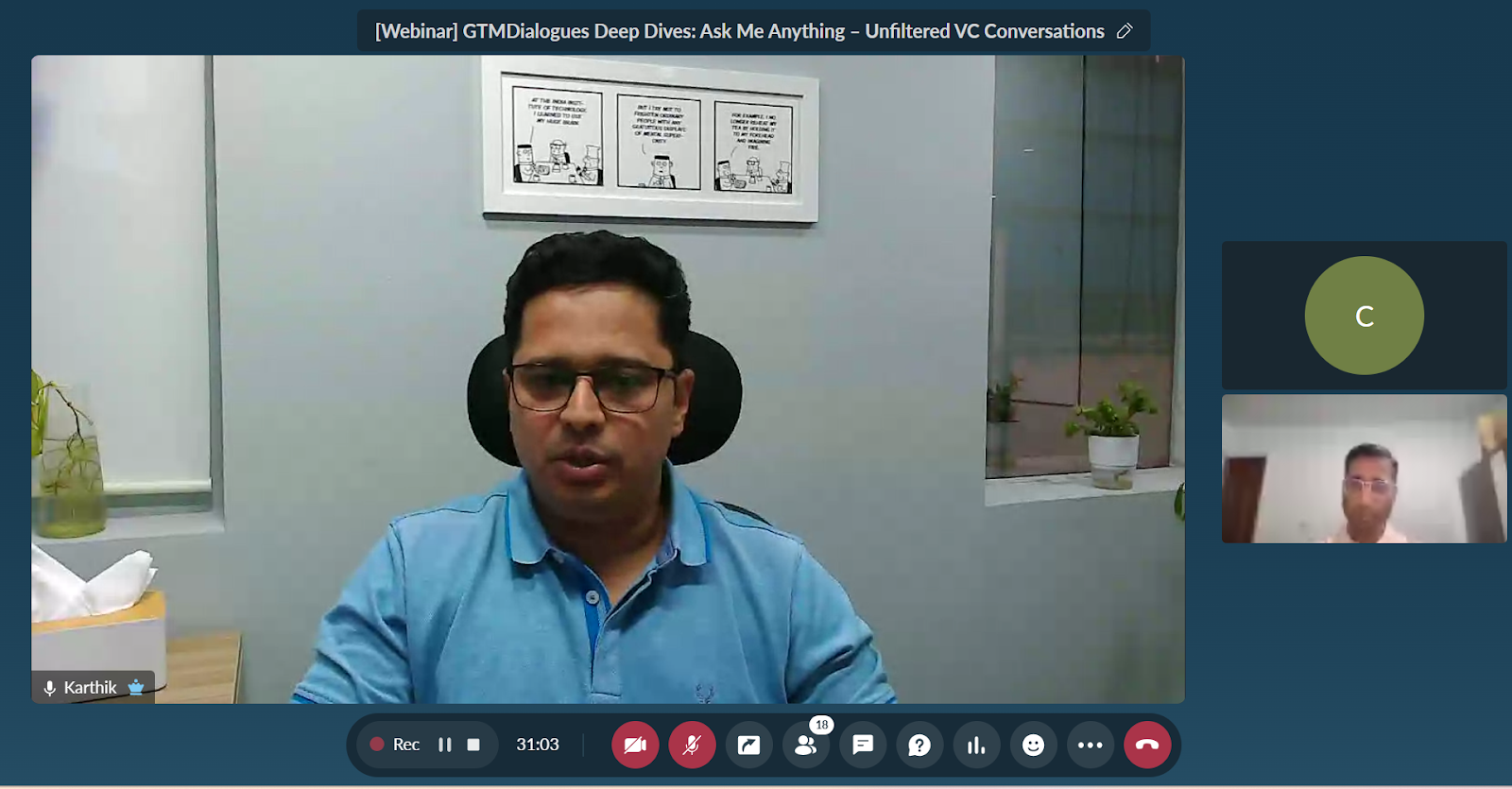
The goal of this session was to let founders hear what VCs look for when nothing is certain in the startup yet. Saurabh Lahoti, Co-Founder, GTMDialogues moderated this session and said, “We want to make sure this isn’t a monologue but a space where founders can interact openly.”
Founders asked the questions about conviction, pivots, CAC, exits, solo founders, and what actually drives a seed-stage yes and Karthik didn’t hesitate to answer them head-on.
This AMA became a rare window into the decision-making mindset behind early-stage investing.
Karthik began his career over two decades ago as an engineer, working on embedded systems.
This was long before “deep tech” became a commonly used term, and his work sat deep in core technology and systems thinking.
A key realization during this phase shaped his next move. As he shared, “A lot of the stuff I was building would come alive after 15–20 years… and I’m more of the here and now.” That pushed him towards areas where technology met real-world adoption faster.
This realization played a major role in pushing him towards venture capital investment.
His professional journey can be understood in three clear phases:
Started his career building embedded systems, developing a strong foundation in how complex technology is designed and shipped.
Entered venture capital through a short internship, where he saw how technology, business, and finance intersect. “I really loved what I did,” he said, which led to over a decade of investing in seed-stage companies.
After years of working with founders, he decided to experience the journey himself. “I’ve been investing in entrepreneurs, but I hadn’t done it myself,” he reflected, which eventually led to starting PeerCapital.
PeerCapital came together through partners from different parts of the ecosystem, a career VC, an operator-founder, and a consultant. Each bringing a distinct view of the zero-to-one journey.
This experience shapes how Karthik evaluates founders today. He recognises patterns he has seen across engineering, investing, and building that often decide outcomes much earlier than numbers do.
When Karthik explained how PeerCapital invests, he described a discipline that comes from knowing exactly where early money creates the most impact.
“We clearly want to be in the zero-to-one phase,” he said, emphasising that they back teams before product-market fit becomes obvious. At this stage, you’re judged on whether your team can shape the first version of something meaningful.
PeerCapital enters when the product is young, the data is incomplete, and conviction has to solely be built around the people. Their focus sits on two themes that continue to expand despite market cycles: the digital consumer economy and the rise of applied AI.
Both areas have real, compounding demand. Both will keep shaping new business models and both give early-stage founders enough room to experiment without running into saturated categories.
To make this focus sharper, they limit themselves to four sectors, where their team already has networks and operating experience. These include interactive entertainment, financial services, healthcare, and enterprise productivity.
Their capital strategy is equally intentional. PeerCapital typically invests ₹4 -15 crore as the first cheque, aiming for 10 - 15% ownership.
“We try to invest at a stage where we can have meaningful shareholding,” Karthik explained, because that structure aligns the fund with long-term outcomes and reduces pressure on founders to chase vanity milestones.
If you step back, the thesis is simple: stay early, stay thematic, and stay close to the sectors where real zero-to-one work still needs to happen.
Karthik spoke about exits as outcomes, he has seen play out across multiple companies over many years. His perspective comes from watching how early decisions compound over time.
As an early-stage investor, he explained that exits are always tied to fund structure. “VC funds typically run for ten years… you invest in the first few years and exit in the next five to six,” he said. From an investor’s lens, this sets a natural time horizon for every seed investment.
Based on his experience, seed investors don’t evaluate exits in one fixed way. They look at whether a company is progressing in a direction that can realistically create options later. Those options usually fall into a few patterns:
In many cases, startups grow steadily by solving a clear problem for a defined customer segment. Over time, this consistency makes them valuable to larger companies looking to strengthen a specific product line or capability.
From an investor’s experience, acquisitions usually happen when a startup proves repeatable execution rather than explosive growth. Strategic buyers care about fit, reliability, and how easily the startup can integrate into a larger organisation.
Some startups show sharp clarity very early, they have strong adoption, clear revenue signals, or fast category leadership. In such cases, early investors may find opportunities to sell part of their stake before the company fully matures.
For seed investors, secondaries or buybacks offer a way to realise returns while the company continues its journey. This often happens when founders or new investors want to restructure ownership without forcing an exit.
IPOs represent the most visible form of exit, but they are uncommon at the seed stage. Karthik described this clearly when he said, “IPO is a black swan event for a seed-stage investor.”
From an investor’s perspective, IPOs depend on many external factors beyond execution, such as market cycles, regulations, and timing.
He also spoke from experience about timing. Some companies show clarity and momentum very early, allowing investors to exit sooner than expected. Others take longer but still deliver strong outcomes because the fundamentals stay intact.
From an investor’s point of view, speed matters less than direction. What matters is whether the company keeps moving forward with intent, even as plans change.
This is also why seed investors focus so much on founders. Metrics shift, markets evolve, and strategies pivot, but the way founders think, communicate, and make decisions stays relatively consistent and that’s what determines whether an exit becomes possible.
For early-stage investors like Karthik, an exit is the conclusion of a long working relationship. And every seed investment starts with the same question: can this partnership realistically reach a meaningful end?
When Karthik spoke about evaluating founders, he was drawing from years of watching early-stage companies grow, struggle, pivot, and sometimes break. From a seed investor’s lens, these patterns show up long before metrics do.
Early-stage VCs know that products will change and markets will evolve. What they are really trying to understand is whether the startup has the right foundation to survive that change. This is how Karthik explained that evaluation.
Seed-stage investing is a multi-year relationship. Investors look for founders whose words and actions stay aligned over time. From an investor’s experience, trust shows up in consistency. Clear communication builds confidence long before scale arrives.
Every early-stage company experiments, and not all experiments work. What investors observe closely is how founders respond when something doesn’t go as planned.
From Karthik’s perspective, mature startups acknowledge issues early and involve investors in the thinking process. That behaviour strengthens the partnership and speeds up problem-solving.
Seed investors expect uncertainty. What they look for is momentum created through learning. If something works, founders who recognise it early create leverage. If something stalls, quick course correction saves time and capital.
Karthik referred to this as learning speed, a signal that often predicts long-term execution strength better than early traction.
Early-stage VCs don’t expect founders to know everything. They do expect clarity on the problem they are solving. Founders with domain grounding make better decisions with fewer iterations.
From an investor’s experience, this grounding helps startups move faster because they avoid relearning fundamentals under pressure.
5. Clear storytelling helps a startup attract momentum
Strong startups communicate their vision clearly, they align investors, customers, and early hires around the same narrative.
Karthik highlighted this because he has seen how clarity compounds. A startup that can explain why it exists builds belief more easily across every stakeholder.
6. A simple framework helps investors assess founder readiness
To make sense of early signals, Karthik uses a simple model shaped by years of investing experience:
Together, these indicate whether a startup can navigate the zero-to-one phase.
7. Behaviour consistently predicts outcomes at seed stage
At the earliest stages, investors bet on patterns of behaviour. Decision-making style, communication, and reaction under pressure reveal how a startup will evolve.
From Karthik’s experience, these signals appear early and stay consistent. That’s why seed-stage investors often form conviction long before the numbers do.
In markets where products look similar, early-stage investors focus on how startups create differentiation beyond features. Karthik explained that founders often win through pricing models, distribution strategies, or execution speed rather than product novelty alone.
From an investor’s experience, these markets demand patience and capital. What builds confidence is a clear explanation of why your approach changes outcomes for customers and how that advantage compounds over time.
India can be a strong market when customers have both willingness and ability to pay. Karthik brought the conversation back to fundamentals like category depth, retention potential, and long-term unit economics.
From a VC’s lens, geography matters less than sustainability. Founders who show clarity on where revenue comes from and how it grows create stronger conviction.
Yes, solo founders do raise capital, and PeerCapital has backed several of them. Investors focus on whether the founder can attract strong people over time and build a company beyond themselves.
From experience, the key signal is commitment from others. When advisors, early hires, or leaders align deeply with the vision, it strengthens investor confidence.
Early traction helps signal interest, but investors also look for clarity on monetisation. Karthik shared that founders who articulate how and when revenue emerges create stronger trust.
From an investor’s perspective, speed to revenue matters because competitive markets evolve quickly. Clear monetisation thinking signals readiness to scale responsibly.
Some sectors carry historical complexity due to past outcomes. Travel-tech, in particular, has seen multiple cycles of experimentation and failure, which makes investors cautious.
Karthik explained that this caution can be addressed through consistent traction and clear unit economics. Over time, strong execution reshapes perception.
How important is CAC at the early stage?
CAC acts as a signal rather than a verdict in the early days. Investors observe how founders interpret CAC and what they do to improve it through learning and iteration.
From experience, startups that understand their acquisition dynamics early make better GTM decisions as they scale.

A Consumer Psychologist, passionate about understanding what drives people to choose, trust, and love brands.